

『Battery Operated Electromagnetic Flow Meter: Sourcing Remote Utility Main Probes』Related information(flow rotameter|digital flow meter|balo meter|hydraulic flow meter|volumetric meter|positive displacement meter|pitot tube flow meter|displacement meter|cfm meter|variable area flow meter|inline flow meter|differential pressure flow meter|calibrated flow meter|velocity meter|paddle wheel flow meter|oval gear flow meter|anemometer hvac|multiphase flow meter|doppler flow meter|thorpe tube flowmeter|heat flow meter)
Battery Operated Electromagnetic Flow Meter: Sourcing Remote Utility Main Probes
Quick Answer: A battery operated electromagnetic flow meter can measure water flow in remote utility mains without AC power. For sourcing, send your pipe size in DN, pressure in bar, temperature in °C, flow range in m3/h, and required signal output to Silver Instruments. We reply with model, price, and lead time within one business day.
Why Utility Main Probes Need Battery Power
Many water utility mains run through valve pits and river intake chambers with no AC power supply. Running a new power cable often costs more than the flow meter itself.
Because of this, battery operated electromagnetic flow meters are now common in Australia, the Philippines, Vietnam, Saudi Arabia, and Chile. They run on a lithium battery pack. They log flow data internally and can send data through RS485 Modbus, pulse, or 4-20 mA to a local RTU or SCADA system.
Key Specifications for Remote Utility Main Probes
Pipe size is the first factor. Most utility mains range from DN80 to DN1200. Insertion electromagnetic flow meters fit these lines without cutting the pipe. For small lines from DN15 to DN50, inline electromagnetic flow meters give better accuracy.
Pressure and temperature matter. Utility water mains normally operate at 4 bar to 16 bar. Some raw water lines reach 25 bar. Silver Instruments can supply PN10 and PN16 ratings. Special PN25 options are available for high pressure raw water mains.
Flow velocity is also important. Potable water, raw water, groundwater, and wastewater all work. The usual velocity range is 0.1 m/s to 10 m/s. A DN300 main can cover roughly 25 m3/h to 2500 m3/h depending on the pipe profile.
Signal output depends on the site. RS485 Modbus RTU is common for SCADA and telemetry. Pulse output works well with battery powered data loggers. 4-20 mA HART works when a small RTU or controller is present.
Battery life is a key buying factor. Most engineers expect 3 to 6 years. Actual battery life depends on measurement interval, data logging frequency, and output mode.
Sourcing Checklist for Utility Flow Probes
Before you send an inquiry, gather a few details. This avoids wrong model selection and long email threads.
Measure the pipe outside diameter and wall thickness. Insertion probes need exact pipe OD and wall thickness for the hot tap or weld-on saddle. Do not guess these values.
Identify the fluid type. Potable water, raw water, wastewater, and reclaimed water require different electrode and liner materials.
Confirm power and communication. Do you need battery only, solar plus battery, or a mix of battery and external DC power? Also confirm whether data goes to SCADA, a data logger, or a telemetry unit.
Send your pipe size in DN, pressure in bar, temperature in °C, flow range in m3/h, and signal output to Silver Instruments. That is the fastest way to get an accurate selection.
Recommended Silver Instruments Models
Silver Instruments supplies battery operated electromagnetic flow meters as inline models and insertion probes. For utility main probes from DN100 to DN1200, we recommend an insertion electromagnetic flow meter with a hot tap ball valve. This design lets you install or retract the prob
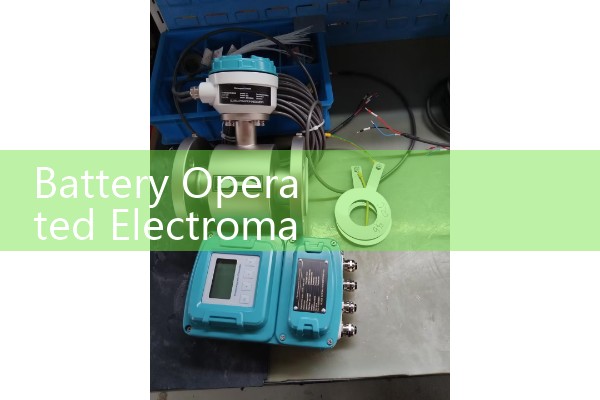
For small lines from DN15 to DN100, we recommend an inline battery electromagnetic flow meter with stainless steel electrodes and a hard rubber or PTFE liner. Common options include IP68 enclosure, RS485 Modbus, and a lithium battery pack rated for 3 to 6 years.
We have seen field issues caused by wrong signal matching. One water authority in the Philippines needed pulse output to a battery powered data logger because the RTU was already in place. We configured the meter for one pulse per 100 liters.
A customer in Saudi Arabia used a battery powered insertion probe on a DN600 potable water main. The line ran 12 km from the nearest power source. The meter has been running for 3 years on the original battery pack.
Installation and Maintenance Notes
Insertion probes need a weld-on saddle or a hot tap fitting. The probe depth must match the pipe inner diameter. If the probe tip is too shallow, velocity readings will be low. If it is too deep, the probe may touch the opposite pipe wall.
Inline meters need straight pipe sections. The common rule is 5D upstream and 3D downstream. For a DN200 line, that means 1000 mm upstream and 600 mm downstream. Some sites have limited space. Ask us about reduced straight pipe options or a flow conditioner.
Grounding is another detail that gets missed. Electromagnetic flow meters need reliable electrical contact with the fluid. For plastic pipes or lined pipes, add grounding rings or grounding electrodes. Otherwise the meter may show unstable readings.
Pricing and Lead Time
Price depends on pipe size, liner, electrode material, communication output, and battery capacity. Inline models from DN15 to DN100 are often the most cost effective. Insertion probes for DN150 to DN1200 are more economical than full bore meters on large mains.
Lead time for standard configurations is usually 5 to 10 working days. Custom insertion probe lengths or special electrode materials may take 15 to 20 working days. We ship to Australia, New Zealand, Southeast Asia, the Middle East, Africa, and Latin America.
For a fast quotation, contact Silver Instruments directly. Tel: +86-135-1213-1526. Whatsapp: 86-135-12131526. WeChat: +86 13512131526. Send your pipe size, pressure, temperature, flow range, and output signal.
Frequently Asked Questions
Can a battery operated electromagnetic flow meter handle wastewater?
Yes. Select a hard rubber liner and stainless steel electrodes. Wastewater conductivity is usually high enough for stable measurement.
What pipe sizes fit an insertion probe?
Most insertion electromagnetic flow meters fit DN100 to DN1200. For smaller pipes, an inline meter is a better choice.
How long does the battery last?
Typical battery life is 3 to 6 years. It depends on measurement interval, data logging, and output mode.
Can the meter send data to SCADA?
Yes. RS485 Modbus RTU is the standard output for SCADA and telemetry. Pulse output works with many battery powered data loggers.
What information do you need for a quote?
Send pipe size in DN, pressure in bar, temperature in °C, flow range in m3/h, fluid type, and required output. Tel: +86-135-1213-1526. Whatsapp: 86-135-12131526. WeChat: +86 13512131526.
 Hot Blog
 Related AD