

『10 GPM Flow Meter: Sizing Low-Velocity Inline Hydraulic and Utility Gauges』Related information(flow rotameter|digital flow meter|balo meter|hydraulic flow meter|volumetric meter|positive displacement meter|pitot tube flow meter|displacement meter|cfm meter|variable area flow meter|inline flow meter|differential pressure flow meter|calibrated flow meter|velocity meter|paddle wheel flow meter|oval gear flow meter|anemometer hvac|multiphase flow meter|doppler flow meter|thorpe tube flowmeter|heat flow meter)
10 GPM Flow Meter: Sizing Low-Velocity Inline Hydraulic and Utility Gauges
Quick Answer: A 10 GPM flow meter for low-velocity inline hydraulic and utility gauges usually fits DN20 to DN40 pipe. Magnetic flow meters work best for water and conductive liquids. Oval gear flow meters handle hydraulic oil and diesel. Always check pipe velocity, fluid viscosity, and the minimum flow cutoff before you buy.
Selecting a 10 GPM inline flow meter sounds simple until you check the velocity. In a DN40 pipe, 10 GPM moves at about 0.5 meters per second. That velocity is fine for many meters. In a DN50 pipe, the same flow drops to 0.3 meters per second. Some turbine and vortex meters struggle at this speed. So pipe size matters more than the flow number.
Silver Automation Instruments supplies flow meters to industrial users in Southeast Asia, Oceania, Latin America, the Middle East, and Africa. Most of these customers run small hydraulic power units, water treatment skids, boiler feed lines, and fuel oil transfer systems. For a 10 GPM line, the fluid type and viscosity decide the best meter.
What 10 GPM Means in Metric Flow Terms
10 GPM equals 37.85 liters per minute. It also equals 0.63 liters per second. That is a common flow for small cooling loops, hydraulic test benches, chemical dosing skids, and utility water branches. A 10 GPM flow meter often lands in DN20 to DN40 pipe. In DN25, 10 GPM gives about 1.28 meters per second. In DN40, velocity drops to 0.5 meters per second. In DN50, it drops further to 0.32 meters per second.
Low velocity can be good for pressure drop. But it can hurt measurement repeatability. The meter may read zero when flow is present if the velocity is below its minimum threshold. Because of this, we ask for pipe size and fluid type first.
Flow Meter Types That Handle 10 GPM
For water, wastewater, and conductive chemicals, a magnetic flow meter is the first choice. Silver Instruments electromagnetic flow meters have no moving parts. They handle solids and dirty water well. A DN25 or DN40 magmeter covers 10 GPM with stable output. Accuracy is typically 0.5 percent of reading. Minimum velocity is around 0.3 meters per second. So a DN40 line at 0.5 meters per second stays above that floor.
For hydraulic oil, gear oil, diesel, or fuel oil, an oval gear flow meter is more practical. Oval gear meters measure volume by counting fixed chambers. They do not need a minimum pipe velocity to work. A 10 GPM oval gear meter for hydraulic test stands gives repeatable readings even at 1 GPM or 2 GPM if sized right. Last year a customer in Vietnam used a 0.5 inch oval gear meter on a hydraulic power unit test bench. The oil viscosity was ISO VG 46. The meter held 0.5 percent repeatability at 10 GPM and 2 GPM. That kind of range is useful when a test stand runs multiple pump sizes.
For compressed air, nitrogen, or utility gas, use a thermal mass flow meter. But the flow unit must change. 10 GPM is a liquid unit. For gas, we size in normal liters per minute or standard cubic feet per minute. If the utility line carries water, stay with a magmeter.
Hydraulic Oil and Utility Water Application Notes
Hydraulic systems have high viscosity oil, sometimes 32 cSt to 68 cSt. Oval gear meters handle that range. Avoid turbine meters in hydraulic oil. The oil viscosity changes with pump load and temperature. A turbine meter calibration shifts with viscosity. Oval gear meters are less sensitive to viscosity change in the 10 GPM range. Some models accept pressures up to 400 bar.
Utility water lines may contain particles, rust, or scale. Magnetic flow meters are line size and obstruction free. They do not clog like small turbine bearings. We have seen this on customer si
Sizing Example for a 10 GPM Inline Meter
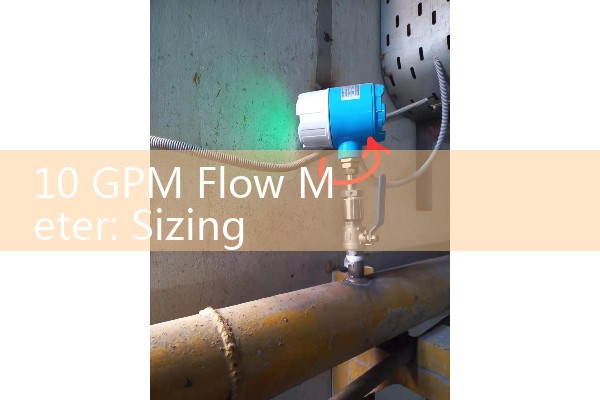
Here is a real sizing example. A customer in Australia has a process water line. Pipe size is DN32. Flow is 10 GPM. Water temperature is 25 degrees C. Pressure is 4 bar. Conductivity is 450 microsiemens per centimeter. We selected a DN25 magnetic flow meter. The velocity at 10 GPM in DN25 is 1.28 meters per second. That is within the 0.5 to 10 meters per second range. Output is 4 to 20 mA HART. Accuracy is 0.5 percent of reading. The customer installed it with 5 straight diameters upstream and 3 downstream. Total pressure drop is less than 0.05 bar.
If the same flow were in a DN50 pipe, we would reduce the meter to DN25 or DN32. This keeps velocity high enough for stable reading. Some users do not want a pipe reducer. In that case an oval gear meter can fit directly into the larger line if the fluid is clean oil or fuel.
Output and Connection Options for 10 GPM Meters
Silver Instruments flow meters for 10 GPM lines usually support 4 to 20 mA, pulse, or RS485 Modbus. Some models have HART overlay for continuous diagnostics. For hydraulic test stands, pulse output is useful for batch volume or leakage testing. For water utility skids, 4 to 20 mA HART connects to PLC and SCADA systems. We can supply battery powered remote displays for sites without panel power.
Connection types include NPT, BSP, SAE flange, and DIN flanges. Hydraulic oil applications often use NPT or SAE threads. Water and chemical lines tend to use ANSI or DIN flanges. We see more DIN flanges in Southeast Asia and Oceania. Threaded connections are common in Latin America and the Middle East for small skids.
How to Request a 10 GPM Flow Meter Quote
Send us these details and we will return a selection in one business day. Fluid type, flow range in GPM or liters per minute, pipe size in DN or inches, viscosity in cP or cSt, pressure in bar, temperature in degrees C, and output needed. You can reach Silver Automation Instruments by phone at +86-135-1213-1526. WhatsApp is 86-135-12131526. WeChat is +86 13512131526.
We ship to Australia, New Zealand, Malaysia, Indonesia, Thailand, Vietnam, Mexico, Chile, Colombia, Nigeria, Kenya, and the United Arab Emirates. Most 10 GPM flow meters ship within 5 to 7 working days from stock or short production.
FAQ: 5 Questions on 10 GPM Flow Meters
Question 1: Can a 10 GPM flow meter work on a 2 inch pipe?
Answer: Yes, but the velocity in a 2 inch pipe is about 0.18 meters per second. That is too low for a magnetic meter. You can reduce the meter body to 1 inch or switch to an oval gear meter for oil.
Question 2: What is the best flow meter for 10 GPM hydraulic oil?
Answer: An oval gear flow meter. It handles ISO VG 32 to 68 hydraulic oil, gives pulse output, and works at low velocities.
Question 3: Can I measure 10 GPM of water with an electromagnetic flow meter?
Answer: Yes, if the water conductivity is above 20 microsiemens per centimeter. Most municipal and process water is above that level. Use DN25 or DN32 for stable readings.
Question 4: What accuracy can I expect at 10 GPM?
Answer: Magnetic meters achieve 0.5 percent of reading. Oval gear meters achieve 0.5 percent repeatability or better. Turbine meters may drift if viscosity changes.
Question 5: Do I need straight pipe for a 10 GPM inline meter?
Answer: Magnetic flow meters need 5 straight diameters upstream and 3 downstream. Oval gear meters do not need straight runs. They are volume counters.
 Hot Product
 Related AD